The team doesn’t get faster when every decision runs through one person. It gets smaller.
We see it constantly. A client has projects they need drawn, not eventually, desperately. We have people on our side ready to draw them. And everything sits, because we’re waiting on one person to find time to answer a handful of questions.
The work isn’t stuck because of capacity. It’s stuck because of one calendar.
This is the pattern in shop after shop, and I’ve lived it myself. When a company doesn’t have a clear process for preparing concise directions and information before a project kicks off or gets handed off, work sits and progress stalls. And when the owner or a key leader won’t delegate — won’t trust people to follow a process and take action on their own, the whole team gets trained to do one thing: wait until they’re told exactly what to do.
That’s the real cost. You don’t just slow the work down. You teach your best people to stop moving without you.
How I learned this the hard way
When I feel stressed and overwhelmed as a manager, it’s almost always the same thing: too much on my plate and not enough time to clear it.
Think about what a manager’s day actually is. You spend it collecting problems. Your engineer tells you what he needs to proceed, and you say, “Okay, I’ll go get that for you, in the meantime, work on this.” You do that ten times a day. By the end of the week you’re carrying a running list of problems only you can go solve or get answers to, and then re-delegate. Some weeks that list gets bigger than you can carry.
At some point I made it a goal to pick just one of those recurring problems and see if I could build a simple decision tree so someone else could solve it without me. Then another. Every time it worked, my team could move a little further before they hit my desk. Do that enough times and the desk stops being the bottleneck.
The GM’s actual job
Here’s the part a lot of owners and GMs get backwards: they’re in the weeds of individual projects. They shouldn’t be.
Your job as a leader isn’t to execute the projects. It’s to make sure your team is following the right processes so projects get executed well. The moment you become a part of the execution — the person every drafter, PM, and estimator has to route through — you’ve capped the whole shop at your personal capacity.
What “handing off a decision” actually looks like
For years, I was the only one who could respond to customers about change orders, redlines, or escalations from past projects. Not because it was hard — because there was no clear decision matrix for how to respond. It all had to come through me.
So I built one. I defined and taught my drafting supervisors how to know when a revision was part of the base scope and included, versus when it required billing extra hours — and then how to communicate that to the client properly. Once that was working, we ran it further back: we trained supervisors to communicate those parameters up front, as part of the initial project completion communication, before anything became a dispute.
That process now runs automatically, without me. That’s the goal, not to make the decision faster, but to make yourself unnecessary to it.
Why owners won’t let go
When I tell an owner to hand off decisions like this, the pushback is almost always the same. It’s a lack of trust in their team, or an inability to articulate how the process should work — often because they can’t even explain how they make the call themselves. And underneath it, they’re emotionally and mentally overwhelmed by the very idea of delegating it.
The reframe I use is simple: imagine what else you could get done if this one thing just worked seamlessly, without you. Once someone can picture that, the trade starts to feel obvious.
Because the cost of not doing it is your best people. Good people don’t function in an environment where they aren’t afforded trust and a real chance to help make the company better. Deny them that long enough and they leave, not because the work is bad, but because they’re tired of being managed instead of trusted.
Where an outside partner actually helps
Most shops assume outside help means one more person waiting at their desk for answers. Done wrong, that’s exactly what it is and it makes the bottleneck worse.
Done right, it’s the opposite. We start by meeting a client where they are: usually without decision trees, and without a lot of trust built into their team yet. Our first job is to define, with them, exactly what we need up front to hit the ground running. Sometimes that starts with a blunt question — “what’s holding you back from answering these questions for us?” and the fix is a five-to-ten-minute daily standup where we show up with everything we need answers on for the day, and then work to shrink that list over time by building real process.
We had a cabinet shop owner who was the classic bottleneck. He couldn’t keep his own team busy, because they had so many questions stacked up waiting on him. We put two full-time people on his work — but the real unlock wasn’t the extra hands. It was building a framework where our team could engage his clients on his behalf, keep him in the loop only on the questions that genuinely needed him instead of treating him as the gatekeeper for everything, and run a daily standup to clear open questions, log answers, and set next steps. The load came off his desk.
The hard truth
Most owners hit their ceiling years ago — a ceiling set entirely by their own individual capacity and they can’t grow past it without delegating. They’ll tell you they can’t find good people to lead. But most of the time that’s not the problem. The problem is they’ve never managed effectively enough, or trusted anyone enough, to let a leader actually lead.
So here’s the one honest question worth sitting with:
Is your team waiting on you more than you’re waiting on them?
If the answer is yes, the constraint on your business isn’t their pace. It’s yours. And that’s good news, it’s the one bottleneck you fully control.
At DuckWorks, we don’t just add drafting hands — we help you build the decision-making and communication process that takes work off your desk instead of piling more onto it. If your team spends more time waiting on you than making progress, let’s talk.
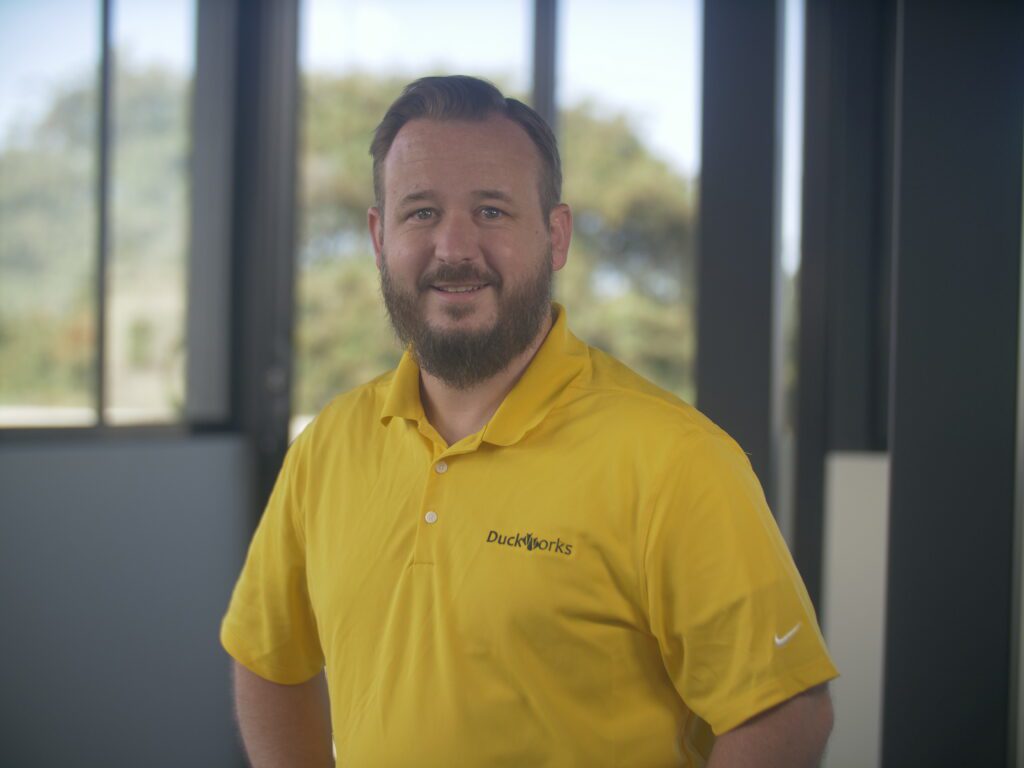
Jacob Edmond
CEO