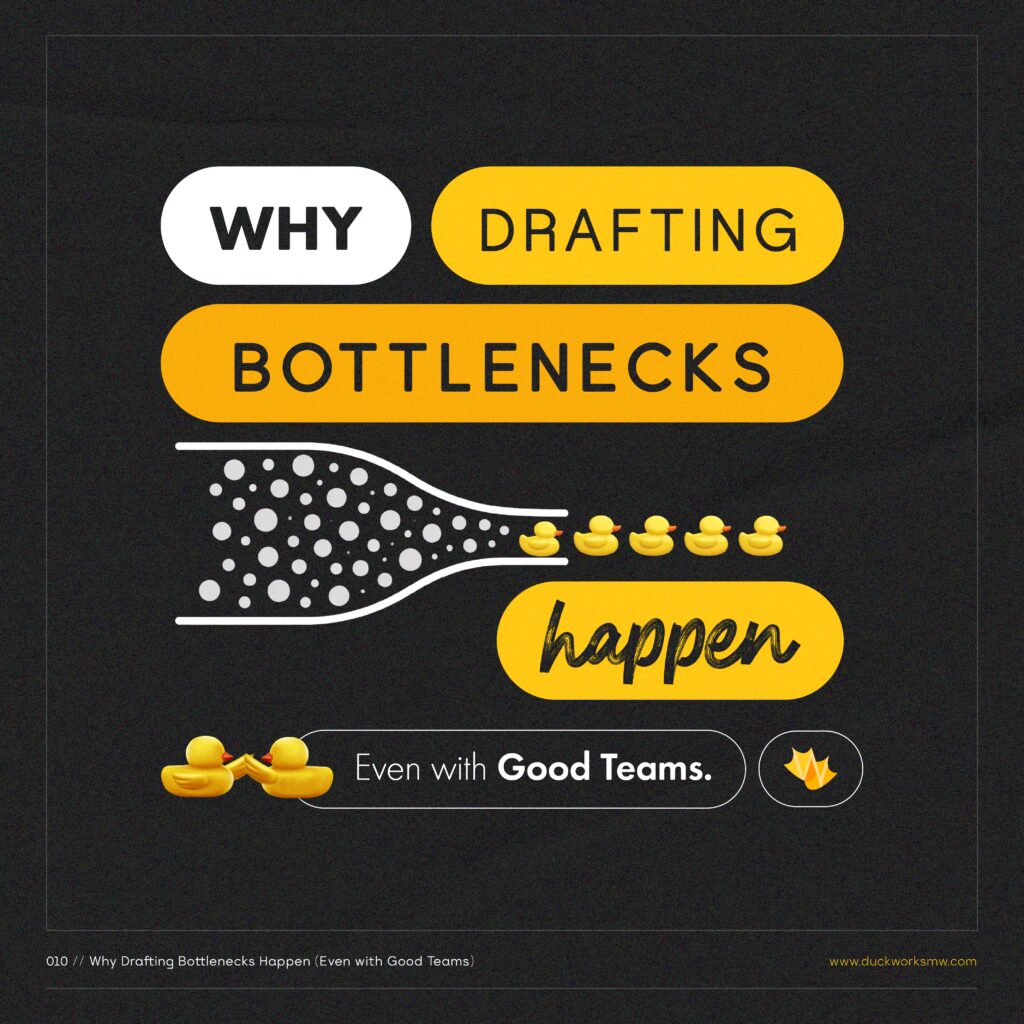

We recently had a project sent back by a client almost immediately.
The issues weren’t subtle. Scope misalignment. Incorrect hardware specs. Questions we asked that were already answered in the documentation.
It would’ve been easy to blame the drafter.
But the real problem started before anyone opened a drawing.
And that’s where most drafting bottlenecks actually begin.
The Real Bottleneck Isn’t Drafting
When projects stall, leaders tend to assume the problem is production speed or technical skill.
In my experience, that’s rarely true.
The real bottleneck is almost always one of three things:
- Autopilot thinking
- Rushed or weak project setup
- No one stepping back to see the whole picture
In this case, our estimator reorganized the scope the way he normally does. It wasn’t careless — it was pattern recognition. He assumed this project worked like the last ten.
But the client had structured it intentionally. We didn’t notice.
That small misalignment at the beginning cascaded through the entire job.
Autopilot feels efficient.
It’s often the source of rework.
Fast Starts Create Slow Projects
We intentionally build setup time into projects. Team leads start early so they can review documentation, clarify scope, and establish standards before the full team begins drafting.
When that time is used well, projects move smoothly.
When it’s rushed — or skipped — the team moves quickly at first and slowly for weeks afterward.
Individual speed doesn’t equal team velocity.
If setup isn’t solid, the team ends up fixing alignment problems instead of engineering solutions.
Standards Only Work If They’re Enforced
We have processes. We create client standards documents. We have frameworks for how work should be structured.
But here’s the uncomfortable truth: having an SOP isn’t the same as following it.
Team leads are responsible for establishing standards when they don’t exist. That requires discipline. It requires pausing long enough to think instead of jumping straight into production mode.
There’s also another layer we’re still working on: documenting what our best team leads do instinctively.
The strongest leaders don’t just follow checklists. They interpret scope. They compare documents. They anticipate where misalignment might happen.
That holistic thinking is what prevents bottlenecks.
The One Check That Changes Everything
If I could fix one moment in every project, it wouldn’t be mid-drafting.
It would be right before submission.
Not a detail check.
A perspective check.
Someone asking:
- Does this actually match what the client asked for?
- Does it align with how we quoted it?
- Does it reflect the standards we agreed on at the beginning?
Drafters working on individual sections can’t see systemic misalignment. They’re focused on their piece.
Someone has to own the whole.
That’s where bottlenecks are either created , or prevented.
What Actually Works
Over time, I’ve learned that preventing drafting bottlenecks comes down to a few simple disciplines:
- Protect setup time. Don’t treat it as optional.
- Require documented standards for every client and project.
- Reinforce those standards consistently.
- Assign someone to step back and look at the project holistically before it leaves.
The solution isn’t more meetings.
It isn’t micromanagement.
It isn’t pushing people to move faster.
It’s getting out of autopilot long enough to see what’s actually in front of you.
Speed matters.
But only when it doesn’t create rework downstream.

Jacob Edmond
CEO